

EU ambassador explains how the €90B Ukraine package will work
 Read NV on Google
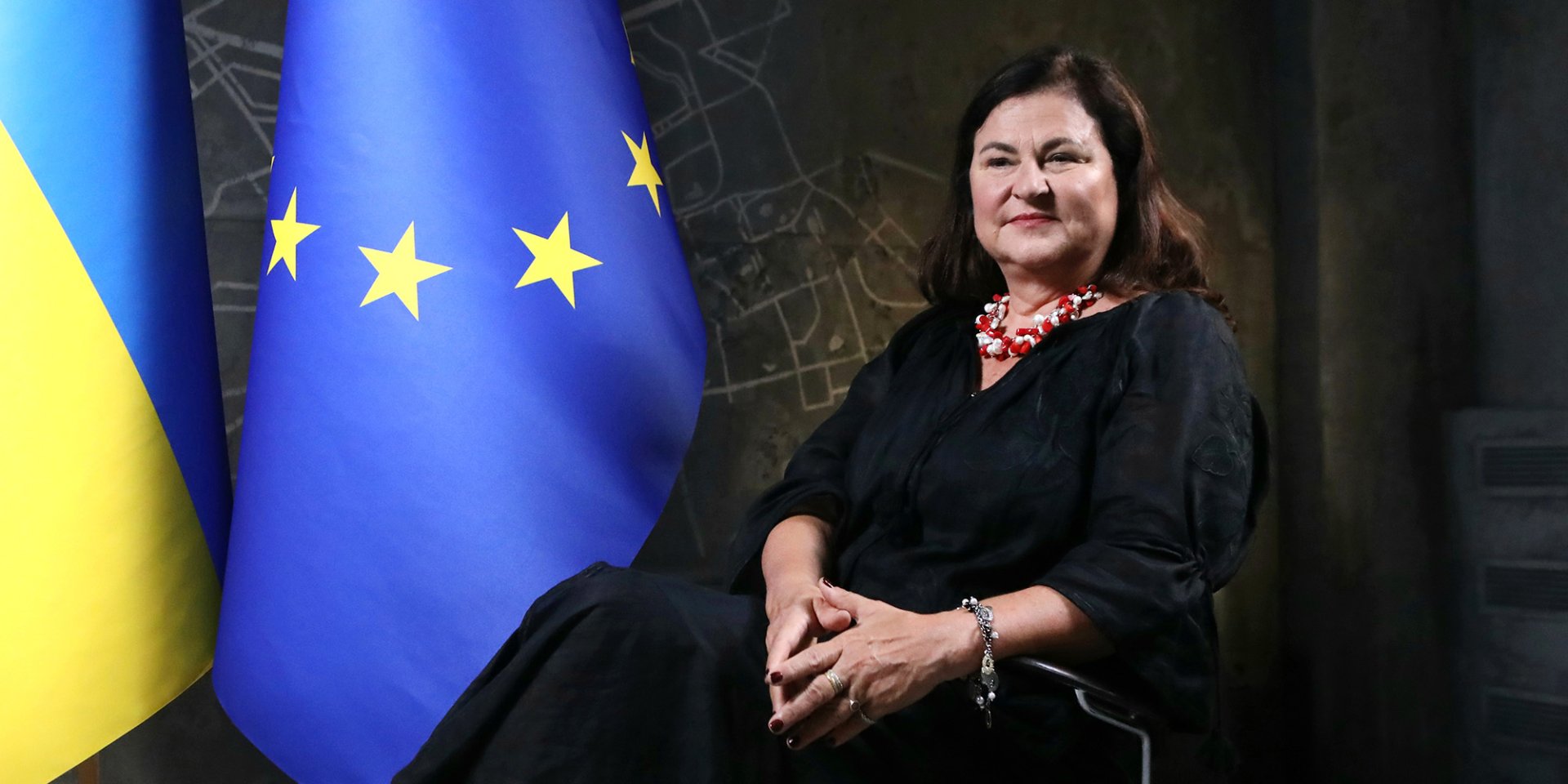
Katarina Mathernova, EU ambassador to Ukraine (Photo: Volodymyr Tarasov/Ukrinform/Sipa USA via Reuters)
As Ukraine faces mounting military and budgetary pressure in the third year of Russia’s full-scale invasion, the European Union is moving to lock in long-term support. In an interview with NV correspondent Nataliia Rop, EU Ambassador Katarina Mathernova explains how a newly approved €90 billion EU support package is structured, why most of the funding is earmarked for defense, and how Brussels plans to move quickly while tying financial aid to reforms and future Russian reparations.
Natalia Rop: The European Commission has published a financial support package for Ukraine with €90 billion for the next two years, out of which €60 billion will be allocated to military support. What does this decision mean at this stage?
Katarina Mathernova: This is an important thing. And it shows that not only the European Union stands with Ukraine, but it delivers. And it delivers very fast. It was a December decision by European leaders to extend the 90 billion euro loan. And already today, before middle of January, the legislative proposal has already been adopted. So, I think that's really important to underline, and also underline the fact that this is a loan of 90 billion. But the terms of the loan are very important, because the loan will only be repaid once Russia pays reparations. So, I think that's a very generous way of structuring it, because if Russia doesn't pay reparations, the loan will not be repaid. So, it essentially is really an expression of unwavering EU support for Ukraine. Now, the loan still needs to go to the co-legislators, that means the Parliament and the Council of the European Union. And that process I expect to take place rapidly, because there is support, cross-party and cross-country support to Ukraine. So, that process should go very fast. And on that basis, the EU will go to the market, borrow the money to extend the loan. And two-thirds of the loan are for military purposes. So, 60 billion out of it is for military purposes, and 30 billion to keep the government running and provision of public services delivered.
— What is the expectation on how soon after this decision will Ukraine be able to receive the first tranche?
— I'm not going to give you an exact date. What everybody is aware of is of the financing needs and financing issues and challenges of Ukraine. So, I think that everybody is working with the date of the end of this quarter in mind. I very much hope that we will be able to deliver by then or very quickly thereafter.
— Are there certain conditions under which Ukraine will be able to receive these funds?
— The budget support, yes. The budget support will be under policy conditions just like policy financing before, and not only since the full-scale invasion, but always in Ukraine. All of our money comes with, all of our budget resources come with conditionality. And those will be defined in the next stages between the Ukrainian government and the EU and the Commission Services.
— Is it already understandable what these conditions will be?
— I don't think they're going to be dramatically different from conditions that we have been having already around the energy system, rule of law, anti-corruption, governance, corporate governance, state-owned enterprises. So, I think these are all issues that, all reforms that we have been consistently working on for a long time, and that support the EU integration ambitions of Ukraine at the same time.
— Are there any restrictions on the countries from which Ukraine can purchase weapons with these funds?
— There is a very clearly stated preference for purchases from Ukraine, the European Union and the EFTA countries [Iceland, Liechtenstein, Norway, and Switzerland]
But there is also the possibility to procure from it, from third countries, which means of course including the United States, for the kind of capabilities and weaponry that is not available in either Ukraine or the European Union. So, then that can be purchased from third countries.
— Do you think there will be specific percentage requirements established — for example, that a certain share of weapons must be purchased from EU countries, and perhaps another portion must be purchased from Ukrainian producers?
— I’m not aware of the percentage being established. I don't know the answer to that. I don’t think there is a percentage established. There is a discussion about the percentages. I’m not aware of percentage. But I’ve not seen the legislative proposal, so I don’t know. Plus, an issue like this can easily find its way into the regulation in the next stages with the co-legislators later.
The military war may be swinging in our favor, but the information war continues.
Just as an army needs soldiers, so does a free society need its journalists to ensure that people have access to honest, trustworthy voices to understand the world around them.
For the past five years, The New Voice of Ukraine has been working tirelessly to push back against Russian narratives and defend democracy. But we cannot do it alone.
Please consider supporting us on Patreon for just $5 a month – your donation does directly to supporting journalists and ensuring that this front of the infowar says solid and defended.
Thank you.
Follow us on Twitter, Facebook and Google News
