

Defense procurement feud exposes rift between Fedorov and Syrskyi teams
 Read NV on Google
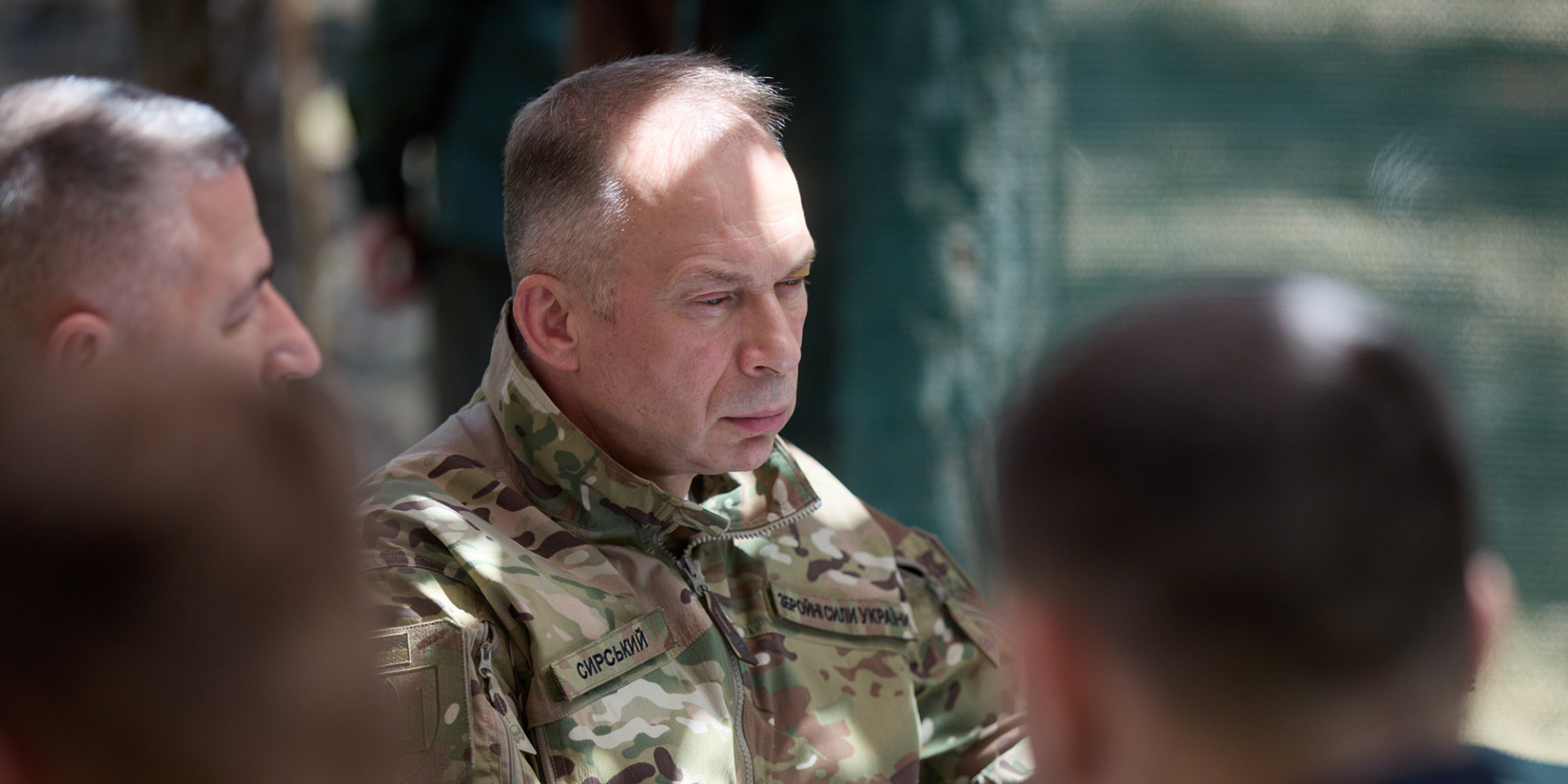
Ukrainian Armed Forces Commander-in-Chief Oleksandr Syrskyi (Photo: Ukrainian Presidential Office)
Experts and politicians familiar with the defense sector
told NV that the Defense Ministry’s push for faster decisions and less
bureaucracy has collided with the slower pace of the General Staff, one of
several disagreements between the two institutions.
The Defense Ministry under Mykhailo Fedorov and the General
Staff under Oleksandr Syrskyi may compete because some of their functions
overlap. The two bodies are closely intertwined and cannot work separately.
Fedorov’s Defense Ministry is trying to make and carry out
decisions quickly while minimizing bureaucracy, while the General Staff works
at a slower pace.
Officials in Fedorov’s ministry may point out that under
Ukrainian law, it is the defense minister who signs off on appointments of
commanders of the branches and services of Ukraine’s Armed Forces. General
Staff representatives, sometimes even publicly, say the ministry is simply a
procurement office.
All of NV’s sources named military procurement as the
biggest flashpoint between the General Staff and the Defense Ministry because
it involves multibillion-dollar budgets and the interests of both state-owned
and private companies.
Vitaliy Shabunin, head of the Anti-Corruption Action Center
and a retired serviceman, said the procurement process involves preparing a
requirements request — a document defining the weapons, ammunition or equipment
needed. Although the two agencies are supposed to determine those needs
jointly, the prerogative to prepare the document has always belonged to the
General Staff.
That is where friction arises between Fedorov and Syrskyi. A
source in parliament told NV that, on one hand, the Defense Ministry does not
agree with the needs the General Staff sets for weapons and military equipment.
On the other hand, the Armed Forces, as the General Staff sees it, are not
getting what they need to fight effectively.
In broad terms, Fedorov believes it is better to buy 10
drones than one artillery round. Syrskyi’s team, however, believes drones
cannot replace artillery for some missions.
Procurement is also a fairly closed process with a heavy
corruption burden. Shabunin and Yuriy Hudymenko, a retired serviceman and head
of the Public Anti-Corruption Council under the Defense Ministry, told NV that
in some cases, instead of listing the characteristics of a certain weapon in a
requirements request, the document names a specific product without adding “or
equivalents.” That sharply narrows the field of potential bidders and triggers
conflicts between the Defense Ministry and the General Staff.
“The General Staff has an opportunity to slip in ‘schemes’
at exactly this stage,” Shabunin said. “If a corruption component is being
built in, it is here.”
The minister, for his part, is trying to turn the war into
data and introduce criteria for measuring effectiveness: e-points for verified
destruction of enemy equipment and personnel, records of strikes, confirmed
videos and other metrics.
“The military has its own logic: We know better. But that is
a very debatable claim,” Shabunin said. “Fedorov is trying to introduce
objective criteria where there have never been any, and that is drawing
resistance from the traditional generals. When objective assessments appear,
resource allocation may no longer be based on what Syrskyi decided, but on
objective indicators.”
A source close to Fedorov told NV that when the Defense Ministry
buys certain equipment, the commander-in-chief may even, as a matter of
principle, formally or informally order that it not be used.
At the same time, the General Staff may make claims against
the Defense Procurement Agency when certain equipment is delivered late or
falls short of quality standards.
The military war may be swinging in our favor, but the information war continues.
Just as an army needs soldiers, so does a free society need its journalists to ensure that people have access to honest, trustworthy voices to understand the world around them.
For the past five years, The New Voice of Ukraine has been working tirelessly to push back against Russian narratives and defend democracy. But we cannot do it alone.
Please consider supporting us on Patreon for just $5 a month – your donation does directly to supporting journalists and ensuring that this front of the infowar says solid and defended.
Thank you.
Follow us on Twitter, Facebook and Google News
