

Putin’s paranoia and the myth of succession
Why has Russian dictator Vladimir Putin suddenly begun
hinting at a successor — despite no real transition of power being planned in
Russia? Political analyst Vadym Denysenko addressed the question in an
interview with Radio NV on May
5.
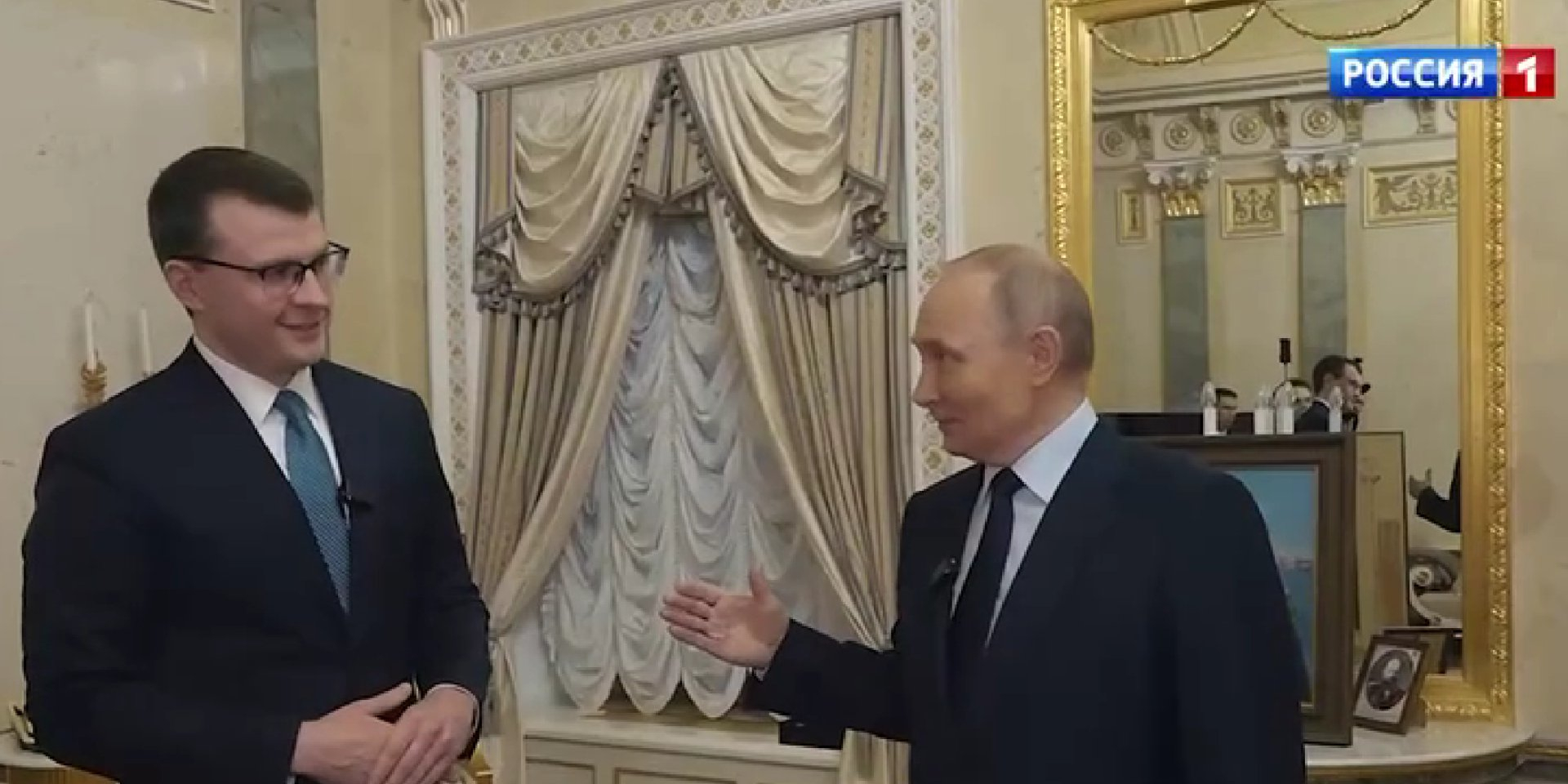
— A new documentary titled Russia, the Kremlin, Putin: 25
Years was released in Russia. It runs for nearly 90 minutes. In it, the
dictator unexpectedly says he’s constantly thinking about who might succeed
him. He hints at having a shortlist and suggests a successor must enjoy the
trust of the people, otherwise, such a president won’t be able to achieve
anything meaningful. “A person must emerge — or better yet, several, so people
have a choice — who could earn the trust of the country’s citizens,” Putin
says. Why is he doing this? Why is he suddenly talking as if someone might come
after him?
— We have to understand that until recently, the subject of
succession was completely taboo — banned under the threat of political
ostracism or even total removal from public life.
The fact that this question was brought up in such a heavily
choreographed film says only one thing: It was Putin’s personal decision to
raise the issue.
As for why he did it, we need to take a brief detour. First,
Russian society really is deeply anxious — and this is one of its greatest
fears. We ran polling on this issue about six months ago, and I don’t believe
the numbers have changed dramatically since. At the time, nearly 60% of
Russians said they were afraid Putin might disappear without naming a
successor. This is genuinely one of the country’s biggest fears.
But the will of the people has never particularly concerned
Vladimir Putin. So I doubt public fears or popular agency are playing a
decisive role here.
In my view, the key factor is likely Putin’s increasingly
paranoid mental state.
Aging dictators often begin to grow paranoid about those
around them. That paranoia, I believe, is what ultimately forced him to start
talking about a successor. But in what context?
First, the talk about choosing between several people
signals that a very slow, long-term process may be in motion — one designed to
ultimately reinforce the idea that there is no one better than Putin.
In many ways, this closely resembles what Joseph Stalin did
when he claimed he was tired and might step down — only to be begged by everyone
to stay and continue ruling the country. Mao Zedong pulled similar stunts. Many
dictators have. It’s a kind of loyalty test for the inner circle — one that
sends a clear message: Whoever dares to name Vasya, Petya, or Seryozha as the
next leader will fall from grace and be cast out.
This is paranoia, yes — but it’s also an attempt to manage
that paranoia by probing the loyalty of those closest to him. That’s how we
should interpret it.
And to repeat: There is no transition of power underway, nor
is any being planned.
— An interesting detail you mentioned: one of the Russian
public’s greatest fears is that something might suddenly happen to Putin and he
won’t point to a successor. Why are they so afraid of that? Can it be explained?
— When you’ve spent 25 years living under the same leader,
you end up with a generation that can’t even imagine things being any
different. It’s a familiar story.
Think back to the death of Brezhnev — many of us probably
remember it. Or consider the stories about Stalin’s death. There’s a sense that
an entire era, a source of stability, the framework you live within, is
vanishing — and beyond it lies the unknown.
There’s a personality cult around Putin. In fact, there’s a
hidden, almost invisible cult of personality built around Vladimir Putin in
Russia. It’s based on the idea that if there’s Putin, there’s Russia; no Putin,
no Russia. That line wasn’t said by accident. It reflects a sense of stability
— the belief that “Putin always outsmarts everyone,” and so on.
After Putin’s death, you enter a realm of uncertainty.
Someone new might be good, or they might be far worse. And it’s important to
understand: the political landscape around Putin is scorched earth. The No. 1
politician is Putin, and the No. 2 — in terms of political weight, not public
trust — is someone like [Communist Party leader Gennady] Zyuganov or [Russian
Prime Minister Mikhail] Mishustin, each polling 50 to 60 percent lower than
Putin.
So, there’s Putin — and there’s a void. From that
perspective, it’s a perfectly logical reaction from a politically suppressed,
deeply undemocratic society in which the notion of freedom doesn’t exist, and
where the freedom of choice hasn’t been on the agenda for a long time.
— If we look at the new figure rising on Russia’s
political horizon — Kirill Dmitriev, who’s already negotiating with U.S.
special envoy for the Middle East Steve Witkoff and is now widely discussed in
Russian media — it seems clear that Putin trusts him. As I understand it, some
are beginning to view him as a “Putin 2.0,” both because he’s younger and
because he’s already established functional contacts with the Americans. Has
the Dmitriev factor and his rapid rise played a role in sparking this whole conversation
about succession?
— We can’t rule that out. I really appreciate the question.
Truly, we can’t dismiss the possibility, because there have
been rumors that Dmitriev is something of a “family appointee.” Why family?
Because his wife is either the best friend or one of the closest friends of
Putin’s daughter — and he’s close to Putin’s family.
That naturally triggered comparisons to Yeltsin and the
so-called “Yeltsin family,” and Yeltsin’s daughter, who at the time was said to
be running many of the levers of power in the Russian Federation. In reality,
the daughter’s role was clearly overstated — just as Dmitriev’s role is being
overstated now.
But speaking of Dmitriev himself, I think it’s worth paying
attention to one thing: it seems that Putin’s old guard — his inner circle —
has received Dmitriev’s rise to prominence rather coldly (to put it mildly).
And yes, they likely see him as a threat.
From what I can tell — and I stress, this is speculation,
not a confirmed fact — that same old guard has tried to marginalize Dmitriev,
to push him into the narrowest lane possible. Because institutionally, he
doesn’t have much power.
All of his influence stems from direct access to Putin. That
counts for a lot, but in the Russian bureaucratic system, it’s often not enough
to get real decisions made. So we can’t rule out the idea that everything
surrounding Dmitriev’s meteoric rise may have prompted Putin to launch, or at
least consider launching, this loyalty test disguised as a conversation about
his successor.
— The price of Brent crude futures for July delivery has
dropped below $59 per barrel. I take it that Russia has already revised its
budget, and there’s not much left in the National Wealth Fund in terms of
liquid assets. What’s going on?
— We need to grasp one simple thing: Russia has enough money
to last through the end of 2025. They’ll manage financially even if their Urals
crude falls below $50 a barrel. Putin knows this. And when he thinks in terms
of a summer offensive — which, for him, has become a kind of Wunderwaffe — he’s
thinking in terms of having no budget issues for the next seven or eight
months. After that, it’s “we’ll see.”
Their Urals oil will soon be hovering just above the $50
mark. That’s critical for them, but it’s not fatal — they can survive on that
for a while.
It’s like that old joke: a man comes home and says, “I got
fired,” and his wife replies, “Thank God, now you’ll stop drinking.” And he
says, “No, I’ll still drink — our kids will just eat less.” That’s exactly the
situation here: they’ll still have enough money for the military-industrial
complex. And for the army.
The military war may be swinging in our favor, but the information war continues.
Just as an army needs soldiers, so does a free society need its journalists to ensure that people have access to honest, trustworthy voices to understand the world around them.
For the past five years, The New Voice of Ukraine has been working tirelessly to push back against Russian narratives and defend democracy. But we cannot do it alone.
Please consider supporting us on Patreon for just $5 a month – your donation does directly to supporting journalists and ensuring that this front of the infowar says solid and defended.
Thank you.
Follow us on Twitter, Facebook and Google News
