


What’s next, banning the word ‘Ukraine’? What Polish nationalists choose to forget when it comes to us
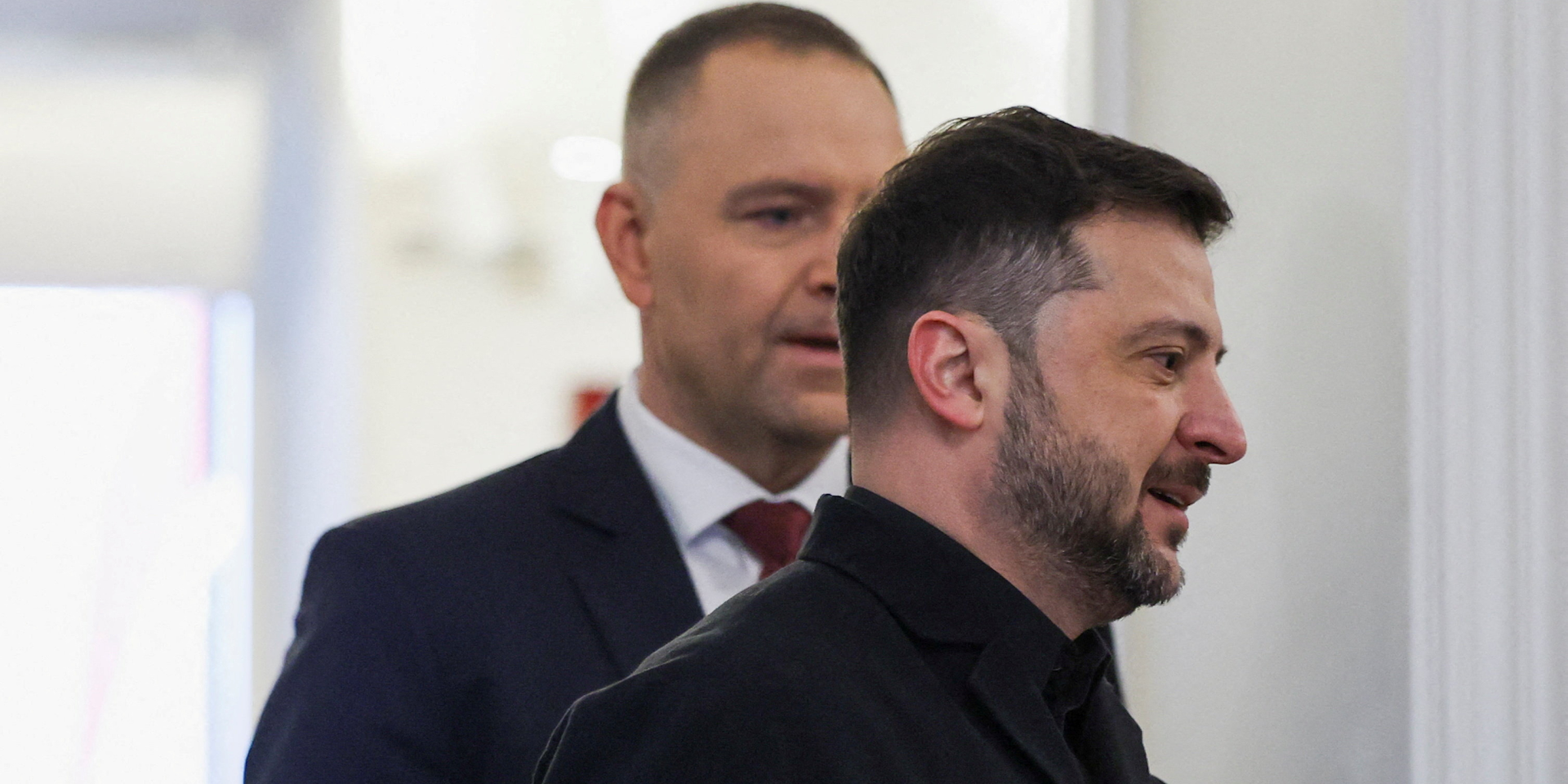
Polish President Karol Nawrocki and Ukrainian President Volodymyr Zelenskyy (Photo: REUTERS/Kacper Pempel/File Photo)
When hundreds of drones are flying over Kyiv, the last thing on Ukrainians' minds is whether the name of a new military unit will offend the Poles.
Radical Polish nationalists would gladly dictate a list of banned words, names, and symbols to us. The red-and-black flag, Bandera, the UPA, the Tryzub – what else will make the cut? This time, Polish President Karol Nawrocki took it upon himself to expand the list, responding to a domestic Ukrainian decision to grant an honorary 'Heroes of the UPA' title to a special forces unit.
I harbor warm feelings toward the Polish people, partly because I am of partial Polish descent myself. My grandmother was Aniela Tyszkowska, daughter of Franciszek, and my godfather was Franciszek Zwierzchowski, son of Józef. While I unquestionably belong to the Ukrainian political nation, my own existence serves as a reminder of how deeply interwoven the histories of Ukraine and Poland are, and how strongly the echo of the Polish-Lithuanian Commonwealth still resonates in Ukraine.
Our family always celebrated both Orthodox and Roman Catholic holidays, and none of our friends were ever bothered by it. On the contrary, everyone wanted to take part in the double celebrations.
When I was a kid, watching a football match at our stadium in Vinnytsia – a city that had only two Ukrainian schools and 33 Russian ones during the Soviet era – the referee was from Western Ukraine. Every time the crowd was unhappy with his calls, the stands would chant 'Bandera!' at him, and I gladly joined in those cheers.
I was seven years old at the time, mind you.
Only later, when I began working with Americans and Canadians from the Ukrainian diaspora and heard the horrific personal stories of how millions of people fled Ukraine to escape the Holodomor and Soviet repression, did I realize how foolish I had been at seven years old.
Since then, I have grown up, shed the burden of propaganda, and accepted the complexity of the world. But clearly, not everyone has managed to do the same.
Last year, Polish border guards harassed an acquaintance of mine from Lviv as he crossed the border, all because of a large Tryzub symbol on his car. They viewed it as an inappropriate display of anti-Polish sentiment. He had to explain that it is the State Coat of Arms of Ukraine – the very symbol depicted on the covers of our passports – and not an attempt to provoke or insult the Polish people. Perhaps soon, the very name 'Ukraine' will begin to offend the sensibilities of Poland's right-wing radicals.
It’s like a minefield, impossible to understand when, where, or what will explode.
I fail to understand why century-old events still dominate the minds of nationalists in 2026. Typically, people turn to the past only when they have nothing to offer in either the present or the future.
I am no great historian, but it is not difficult to see that the Volhynia tragedy – while brutal and entirely unjustifiable – was simultaneously a reaction to a prior, equally brutal colonization that restricted the religious, civil, and political rights of Ukrainians, reducing us to second-class citizens. Looking at the map, it is obvious that Volhynia is Ukrainian land. It was subject to an unbridled colonization attempt by Poland at the time. Polish nationalists conveniently ignore this context, focusing exclusively on Bandera and the UPA.
At the same time, Bandera was one of the biggest enemies of the Soviet regime, which was also occupying Poland at the time. He died at the hands of a KGB agent in Munich. To this day, his name remains a nightmare for Russian propagandists and served as one of the pretexts for an invasion that has now lasted four and a half years and claimed the lives of over one hundred thousand Ukrainians.
Similarly, Symon Petliura was gunned down by a Soviet agent in France.
Likewise, hundreds of Ukrainian literary, musical, and theatrical geniuses – collectively known as the Executed Renaissance – were murdered in Siberian labor camps.
All of these people are a part of the Ukrainian national identity and our centuries-long resistance against Russian imperialism. When this pantheon is invoked in Ukraine today, it is always in the context of Russia, not Poland.
It is both cynical and plain foolish that our friends and partners choose to conjure the ghosts of the past at the exact moment when all of Ukraine is reeling from the most devastating Russian strike on civilians since the start of the war, even as the country braces for new attacks.
These days, Ukrainians are not thinking about Poland, nor are they dwelling on historical figures from a century ago.
Right now, every Ukrainian is focused on how to hold the front line. Around me, people in Kyiv are thinking only of how to quickly find an underground parking garage or a basement to protect their children during the next air raid. And how to find the strength to go to work the next day and send their child to school, knowing the sirens will continue to wail in the day as well.
Remember the last and only air attack on Poland? There were 19 drones. In Kyiv, we frequently face 600 drones in a single night, alongside another 30 to 90 missiles. The last thing on our minds right now is how naming a unit after the Heroes of the UPA will be perceived outside of Ukraine – a unit where many fighters may soon give their lives in the war against Russia.
We do not lecture the Poles on their mythology or their pantheon of heroes. We believe they are mature enough to make their own choices, and we expect the same in return.
No two neighboring peoples in Europe share a spotless common history free of dark chapters. Those who focus exclusively on the past are merely trying to hide their lack of vision for the future.
Ukraine has a centuries-long history of resistance against Russian imperialism and possesses its own heroes who help shape its identity – at times with a distinctly anti-Russian slant. Today, Kyiv is bleeding, enduring a turning point in its civilizational struggle to achieve a final break from Moscow.
This is not the time for friendly nations to reopen old wounds.
And a final note: Poland got lucky with its geography. We, too, would like to have Germany and the Czech Republic as neighbors, and a massive nation standing between ourselves and Russia. But we do not. I hope Poland's right-wing populists are capable of appreciating this geographic reality.
The military war may be swinging in our favor, but the information war continues.
Just as an army needs soldiers, so does a free society need its journalists to ensure that people have access to honest, trustworthy voices to understand the world around them.
For the past five years, The New Voice of Ukraine has been working tirelessly to push back against Russian narratives and defend democracy. But we cannot do it alone.
Please consider supporting us on Patreon for just $5 a month – your donation does directly to supporting journalists and ensuring that this front of the infowar says solid and defended.
Thank you.
Follow us on Twitter, Facebook and Google News
