

ISW: Ukraine’s battlefield gains leave Putin without Victory Day boasts

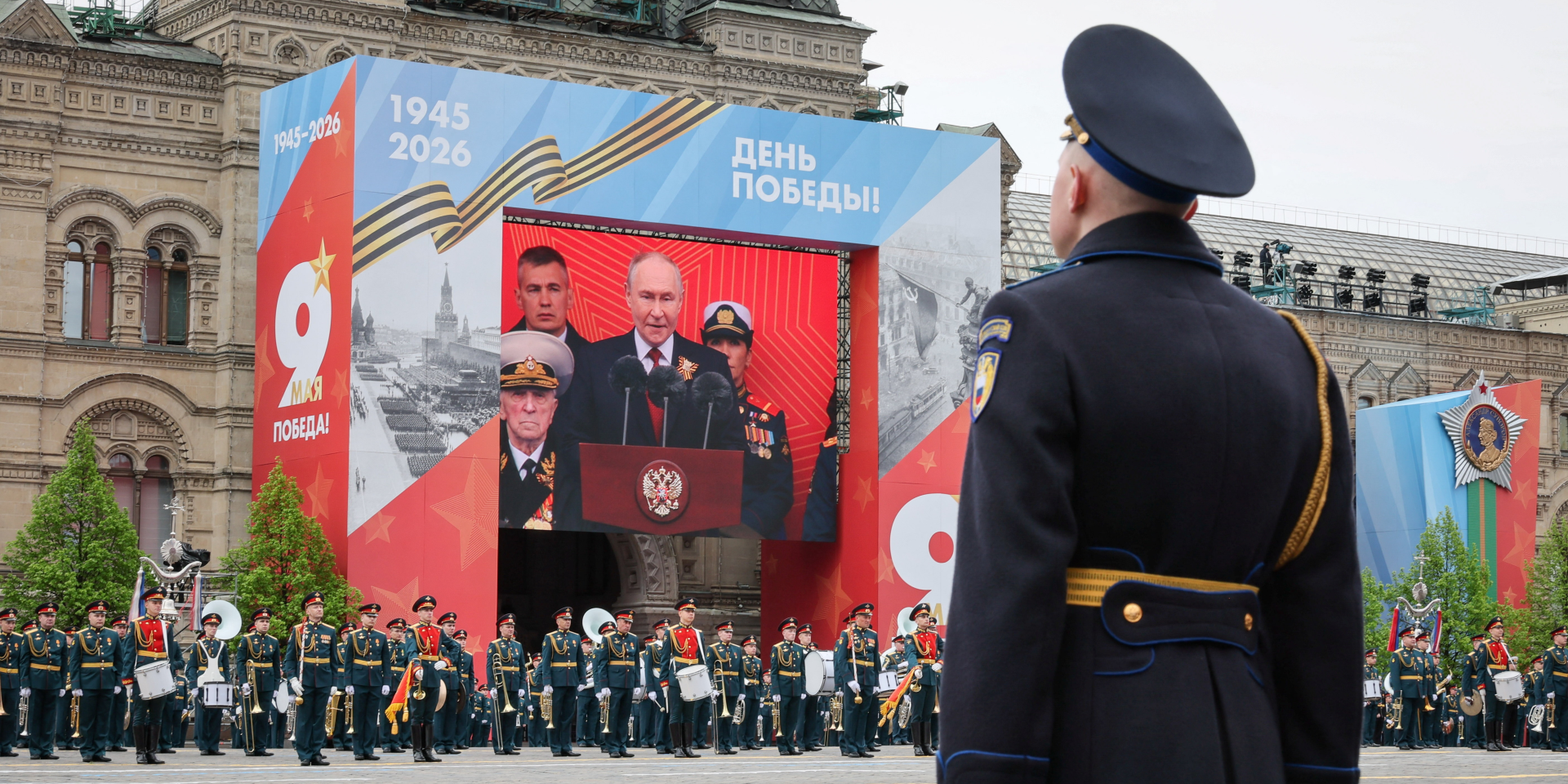
Vladimir Putin did not mention the front line in Ukraine on May 9 because he could not point to any significant successes by the Russian army. (Photo: Sputnik/Vyacheslav Prokofyev/Pool via REUTERS)
The scaled-back Moscow parade on May 9 showed mounting
pressure on Russia in the fifth year of the war, while Ukraine’s battlefield
gains left dictator Vladimir Putin unable to cite any Russian operational
achievements during the celebrations, the Institute for the Study of War said.
Analysts said the war in Ukraine forced Putin to hold
Russia’s Victory Day parade on a far smaller scale than in previous years
because the Kremlin cannot reliably defend areas deep inside Russia, including
Moscow, from Ukrainian drones. The parade lasted only 45 minutes, featured no
tanks or other military equipment for the first time since 2007, and was
attended by only 10 foreign leaders, compared with more than 20 in 2025. The
parade also featured North Korean soldiers for the first time.
The parade was preceded by a series of successful Ukrainian
strikes on areas deep inside Russia that the Kremlin largely failed to defend
despite redeploying air defense systems. The shortened format shows that four
years of war are taking an increasing toll on Russia, ISW wrote.
At the same time, Putin’s insistence on holding the parade
despite the threat of Ukrainian drones reflects his refusal to acknowledge
current battlefield realities and his desire to restore Russia’s imagined
Soviet “greatness.”
Moscow’s demands for a ceasefire during the celebrations
were “a deliberate attempt to project a sense of power and control in Russia,
while seeking to avoid the embarrassment of potential Ukrainian strikes” during
its “main patriotic holiday,” ISW wrote.
ISW analysts also noted that Putin avoided discussing the
battlefield situation in Ukraine during the May 9 celebrations, saying only
that Russia’s victory was “inevitable.”
Over the past year, Russian forces have failed to achieve
any operationally significant advances. ISW described Russia’s most recent
“successes” as the capture of Toretsk in August 2025 after a 14-month campaign,
Siversk after a 41-month campaign and Pokrovsk in January 2026 after a two-year
campaign. In all cases, the seizures caused high Russian casualties and equipment
losses, and Russian forces failed to turn them into further operationally
significant advances.
Russian forces have so far made minimal progress in their
spring-summer 2026 offensive against Ukraine’s Fortress Belt. Russian troops
first infiltrated Kostyantynivka, the southernmost city in the Fortress Belt,
in October 2025 and have failed to make operationally significant gains over
the past six months.
By contrast, Ukraine’s Defense Forces achieved their
greatest battlefield gains in winter and spring 2026 since Ukraine’s incursion
into Kursk Oblast in August 2024. Ukrainian troops retook more territory than
Russian forces captured in April 2026, liberated large parts of Kupyansk, more
than 400 square kilometers in southern Ukraine and several settlements in
western Zaporizhzhya Oblast.
Ukrainian counterattacks in southern Ukraine have forced
Russia to choose between defending against Ukrainian counterattacks and
allocating manpower and resources to priority front-line sectors, ISW wrote.
Ukraine’s intensified mid-range strike campaign against
Russian logistics, military equipment and manpower has degraded Russia’s
ability to conduct offensives. Its long-range strike campaign against Russian
military and oil infrastructure deep inside Russia has also significantly
disrupted Russian front-line communications and drone operations, as well as
Russia’s oil and gas revenues, ISW analyzed.
The parade on Red Square in Moscow on May 9 lasted
only 45 minutes, making it the shortest in modern Russian history. For the
first time since 2007, the parade featured no military equipment, with footage
of weapons in action shown instead. Internet shutdowns accompanied the event in
central Moscow.
A three-day ceasefire in the war has been in effect since
May 9 under a U.S.-mediated agreement. Ukraine pledged not to attack Red Square
during the parade — a condition ISW said Ukraine observed — while Russia and
Ukraine had not yet carried out a reportedly agreed 1,000-for-1,000 prisoner
exchange as of May 9.
The military war may be swinging in our favor, but the information war continues.
Just as an army needs soldiers, so does a free society need its journalists to ensure that people have access to honest, trustworthy voices to understand the world around them.
For the past five years, The New Voice of Ukraine has been working tirelessly to push back against Russian narratives and defend democracy. But we cannot do it alone.
Please consider supporting us on Patreon for just $5 a month – your donation does directly to supporting journalists and ensuring that this front of the infowar says solid and defended.
Thank you.
Follow us on Twitter, Facebook and Google News
