

Russia needs decades to ruin all food warehouses - Ukrainian retail tycoon
 Read NV on Google
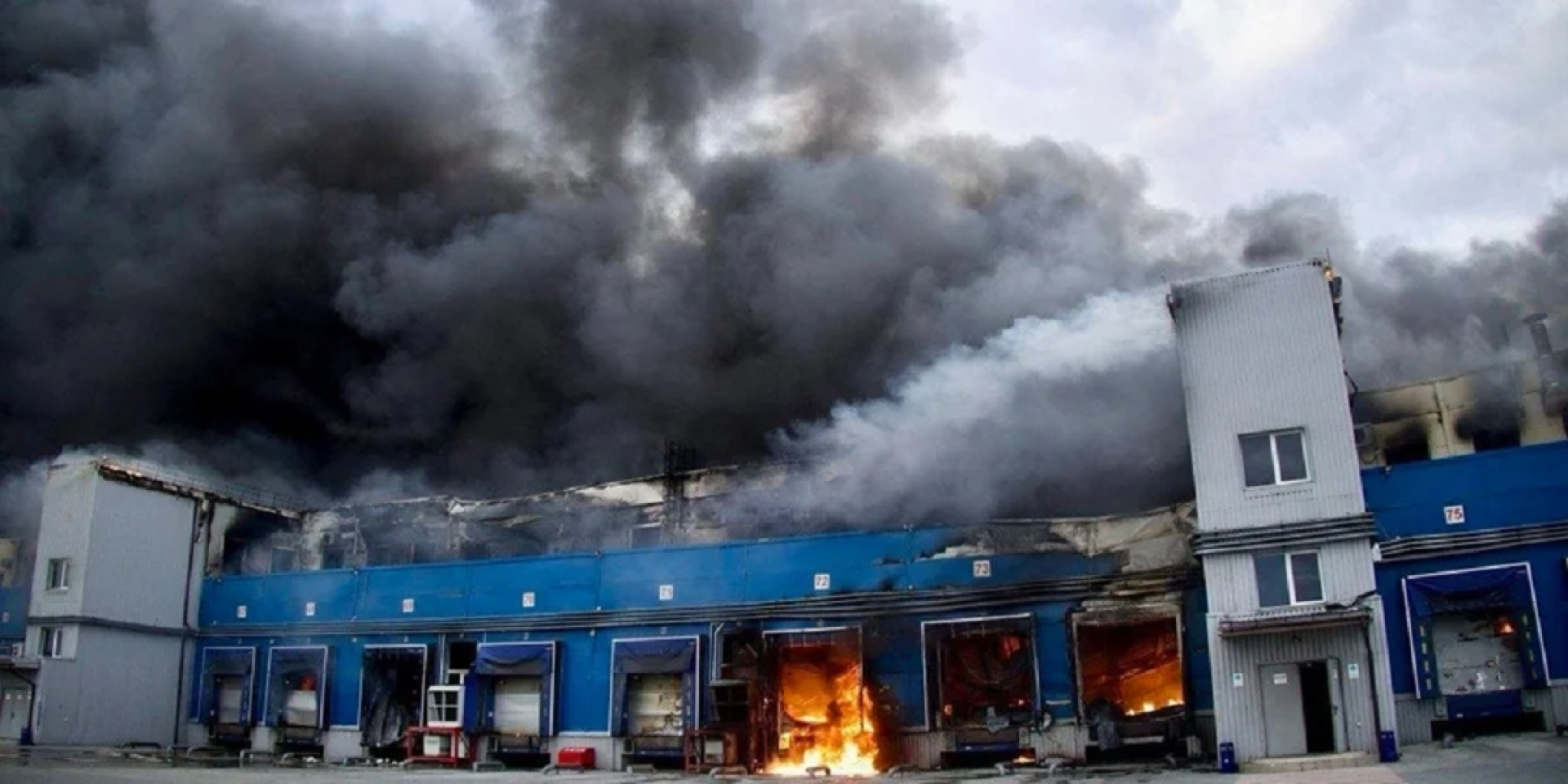
Russia attacked ATB retailer's warehouses in Dnipro (Photo: Oleksandr Hanzha / Dnipropetrovsk Military Administration/ Telegram)
Russia has destroyed 2.1 million square meters of Class A and B+ logistics space since the start of the full-scale invasion, but 90% of storage is not wiped out, retail co-owner Ruslan Shostak wrote on Sept. 11.
Writing on Facebook, the co-owner of retail chains EVA [drogerie - ed.] and Varus [Grocery supermarket chain - ed.] and president of Terwin Corporation addressed reports across Ukrainian media outlets claiming that 90% of all warehouse space in the country had been eradicated, which later spurred viral social media imagery of empty grocery shelves.
"I believe circulating this kind of disinformation only plays into the enemy's hands. We must take a critical view of numbers and facts," Shostak wrote.

He detailed the state of the logistics sector, noting that prior to the 2022 full-scale invasion, Ukraine possessed approximately 4.2 million square meters of Class A and B warehousing. Since the onset of the invasion, another 800,000 square meters were commissioned, bringing the overall inventory of top-tier space to roughly 5 million square meters.
Of that total, 2.1 million square meters were destroyed — including 1.5 million square meters in Kyiv Oblast alone. Furthermore, roughly 900,000 square meters were lost between January and September 2026.
"In total, Ukraine had 5 million square meters of warehouse space. With 2.1 million square meters destroyed, approximately 2.9 million square meters remain intact. In other words, virtually 50% of top-tier facilities," Shostak explained, noting that across large industrial enterprises nationwide, there are tens of millions of additional square meters spanning other facility classifications.
At current rates of Russian bombardment, Shostak estimated it would take Moscow decades to destroy 90% of Ukraine’s storage capacity — assuming zero domestic reconstruction takes place.
"Therefore, I view the circulation of these reports as an attempt to undermine the reputation of Ukrainian logistics and manufacture panic inside the country through manipulative tactics," he emphasized.
While acknowledging that strikes on stores and distribution hubs impose heavy operational challenges on retail chains, Shostak urged citizens to refrain from panic buying.
"It is bitter to admit, but what is happening now is a genuine tragedy. If anyone wants to support their favorite chain, come in and shop. That is the best form of support under current conditions," he wrote.
Shostak guaranteed that nationwide consumer shortages will not materialize, noting that affected chains require at most two weeks to resume operations and reroute logistical corridors.
"There will be no shortage in Ukraine. You will always find what you need — if not in one store, then in another," Shostak stated.
"If one store is destroyed, another will open in its place tomorrow. And there are thousands of domestic manufacturers ready to replace your favorite items."
Shostak disclosed that another company retail location recently burned down, preceded earlier by the destruction of a Varus distribution warehouse. However, he noted he has largely stopped publicizing these incidents to focus on constructive solutions rather than alarming the public.
The entrepreneur identified the absence of war-risk asset insurance and the lack of accessible preferential lending programs for large enterprises as the primary existential hurdles facing domestic business.
In his assessment, the foremost duty of the Ministry of Economy, Environment, and Agriculture of Ukraine is to deliver viable war-risk support instruments to the marketplace: "If this does not happen, Ukrainian business will not survive."
Russian strikes on Ukrainian warehouse and retail infrastructure
Aug. 5: A devastating missile barrage on Kyiv and Kyiv Oblast killed 17 civilians as 28 missiles evaded air defenses. The strikes wiped out Rozetka’s $70 million distribution hub in Brovary — forcing nationwide layoffs — alongside major logistics complexes and manufacturing assets belonging to Epicentr [home improvement and DIY hypermarket - ed.], Nova Poshta, Silpo [premium grocery supermarket chain - ed.](killing six staff members), Novus [food retail - ed.], Intertop [omnichannel fashion and footwear retailer - ed.], Puma, and Bosch. Eleven major corporations suffered billions of dollars in cumulative losses in a single night.
Aug. 28: Minister of Agrarian Policy and Food Taras Vysotskyi stated that Russian attacks had degraded approximately 90% of logistics infrastructure specifically serving domestic grocery chains, warning of moderate price increases.
Aug. 31 – Sept. 6: Russian strikes sustained pressure on supply chains across Kyiv, Odesa, and surrounding oblasts, hitting an Auchan warehouse, an Odesa Nova Poshta terminal, an Ukrzaliznytsia rail depot, and distribution hubs for Varus [food store - ed,] , Avrora [Dollar-store chain - ed.], and Dnipro-M [Power tools and hardware store - ed.]. Municipal industrial targets included an Irpin manufacturing plant, a Coca-Cola facility in Kyiv Oblast, and pharmaceutical hubs Biokon and Teva, which was struck twice in one day.
The military war may be swinging in our favor, but the information war continues.
Just as an army needs soldiers, so does a free society need its journalists to ensure that people have access to honest, trustworthy voices to understand the world around them.
For the past five years, The New Voice of Ukraine has been working tirelessly to push back against Russian narratives and defend democracy. But we cannot do it alone.
Please consider supporting us on Patreon for just $5 a month – your donation does directly to supporting journalists and ensuring that this front of the infowar says solid and defended.
Thank you.
Follow us on Twitter, Facebook and Google News
