

 Read NV on Google
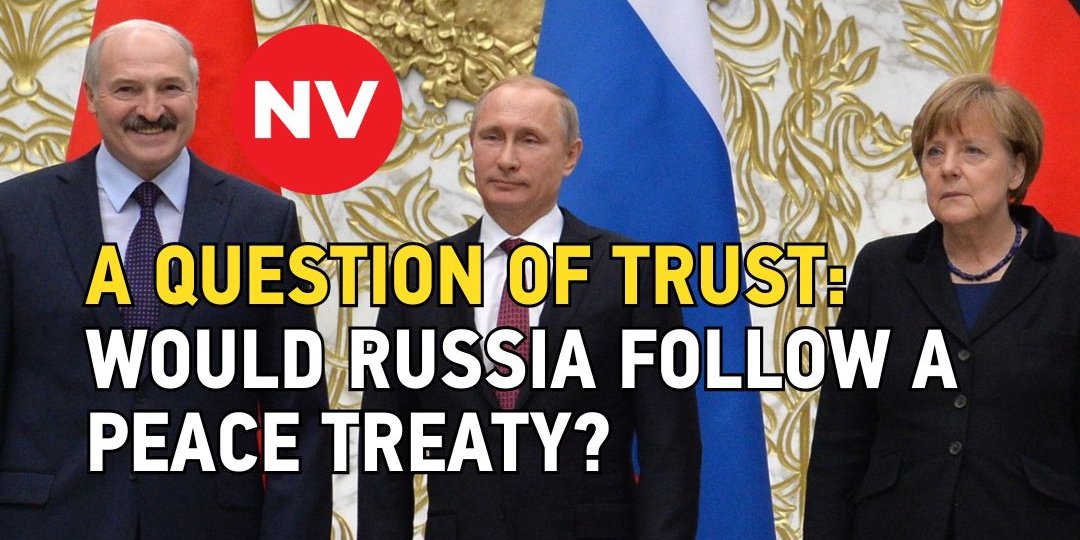
National leaders at the Minsk II Summit in 2015
Can Russia be trusted? That's the question that is at the core of the U.S.-backed “peace plan” in fevered diplomatic development across two continents. For Ukrainians, and Ukrainian President Volodymyr Zelenskyy, the answer has already been given.
“[Putin] is a liar, you can count on it,” Zelenskyy told U.S. President Donald Trump at a security conference in 2025.
The statement was not made in jest.
The Ukrainian experience is that Russia has repeatedly violated every agreement it has made. Since declaring independence from the Soviet Union in 1991, Ukraine has negotiated numerous treaties with Russia: agreements on border relations, mutual non-aggression, and on dispensing with the remnants of the USSR. Then, systematically, Russia broke all of them. Therefore, no matter what the details of an armistice may be, the popular question asked by Ukraine’s defenders is whether they – or their children – would have to be called to fight once again if Russia violated another.
The New Voice of Ukraine has catalogued the most important of these treaties, and how often Russia has gone back on them.
A question of trust: Would Russia follow a peace treaty?
1994 — Budapest Memorandum on Security Assurances
The Budapest Memorandum was one of the most consequential moments in the early history of independent Ukraine. Each former Soviet subject inherited the military assets stationed within its borders, including nuclear weaponry. This meant that Ukraine, Russia, Belarus, and Kazakhstan all became nuclear powers upon independence. In 1994, Ukraine agreed to relinquish its nuclear arsenal to Russia in exchange for Russia, the United States, and the United Kingdom assuring that they would not use military or economic force to violate Ukrainian “territorial integrity or political independence.”
The administration of then-President Leonid Kravchuk had last-minute reservations about the treaty as it would have left Ukraine vulnerable, especially given the emergence of nationalist elements in Russia. But U.S. President Bill Clinton pressured Kyiv, warning that backing out would severely damage U.S.-Ukrainian relations.
Ukraine voluntarily surrendered its nuclear stockpile, as complicated and problematic as it would have been to keep it, on the assurance that it would not need them to protect its sovereignty. Those assurances proved to have no basis in fact.
1997 — Treaty on Friendship, Cooperation and Partnership
The 1997 Friendship Treaty is also known as the “Big Treaty” because of its broad-reaching declarations on how Russia and Ukraine were “friendly, equal and sovereign States,” who agreed to “base their relations on mutual respect and trust, strategic partnership and cooperation.” Moscow and Kyiv confirmed they would respect each other’s territorial integrity and would not attack one another.
The treaty was annulled in 2018, after Russia violated Ukrainian territorial integrity with its initial invasion in 2014.
2003 — Treaty on the State Border
Even though Ukraine and Russia agreed to the inviolability of each other’s border in the Big Treaty, what that exact border was had not been entirely delineated. The Treaty on the State Border provided for the full survey and marking of the Russo-Ukrainian border. However, even prior to the Treaty's ratification, Russia began the Tuzla Island Conflict over an island in the Kerch Straight to put pressure on the Crimean border.
Nonetheless, Vladimir Putin said in 2008 that “Crimea is not a disputed territory…Russia has long recognised the borders of modern-day Ukraine. On the whole, we have completed our talks on borders. The issue of demarcation still stands, but this is just a technicality. I think questions about such goals for Russia have ‘provocative undertones.’”
2003 — Treaty on Use of the Sea of Azov and the Kerch Strait
While the Treaty on the State Border concerned the land, the Treaty on Use of the Sea of Azov and the Kerch Strait was about the sea. The Sea of Azov and Kerch Straight form the nautical boundary and serve as the waterway for the Ukrainian ports of Mariupol and Berdyansk, and the Russian ports of Taganrog and Rostov-on-Don. This treaty defined these bodies of water as the interior waters of both countries and allowed ships from them free navigation.
Following the Russian invasion and illegal annexation of Crimea in 2014, the Russian Federation has repeatedly violated this agreement by blocking access to the Sea of Azov, as well as detaining sailors en route to Ukrainian Azov ports.
2010 — Kharkiv Pact
Ukraine and Russia have made numerous agreements since 1991 on how to split the Black Sea Fleet and the former Soviet naval base in Sevastopol, Crimea. The Kharkiv Pact of 2010 was touted as the last. According to the principles of the dissolution of the Soviet Union, anything in Crimea should have defaulted to Ukraine. However, the strategic importance of the Soviet Black Sea Fleet made this aspect of Soviet administration an extremely sensitive issue. Russia and Ukraine agreed to split the Fleet between themselves, while Russia commercially leased the base in Sevastopol from the Ukrainian government. The Kharkiv Pact specifically extended that lease until 2042.
Russia seized Sevastopol, along with the rest of the peninsula and much of the Fleet, by force in 2014. Its flagship, the Moskva, was sunk in a Ukrainian strike as it commanded a blockade of the Black Sea in 2022.
2014-2015 — Minsk Agreements
In 2014, Russian covert operations military detachments created and then supplied irregular militias in Ukraine’s Donetsk and Luhansk oblasts. By August of that year, those militias were nearing defeat, requiring the Russian Federation to deploy the regular Russian army at the Battle of Illovaisk, in order to stave off a Ukrainian victory. This was a devastating defeat for Ukraine, leading Kyiv to agree to the Minsk Protocol in September, also known as Minsk I. Minsk I provided for an ill-defined “self-governance” in the Donbas, as the region is also known, in exchange for a ceasefire.
By the end of that month, Russia initiated the Second Battle of Donetsk Airport.
The winter of 2014-2015 saw intense fighting, including the capture of Donetsk Airport. With Ukrainian forces again under pressure at the Battle of Debaltseve, Kyiv again agreed to a ceasefire with Minsk II on February 12th. The Russian side declared unilaterally that the truce did not apply to Debaltseve. Ukrainian military and civilians withdrew under fire through a promised “green corridor” by February 20th. Active Russian military operations never fully abated in the years following Minsk II, with Russia routinely violating ceasefires along the Donbas frontline.
To further cement their reputation, Russian leadership, including Russian dictator Vladimir Putin, presented themselves as merely intermediaries rather than as belligerent.
In February 2022, Russia abandoned the pretence of adherence to the Minsk Accords, annexed the Donbas, and began the full-scale invasion of Ukraine.
According to the United Nations, at least 53,000 civilians have been killed as a consequence of Russian aggression in 2025, and Ukrainian military casualties are estimated to have reached in excess of 400,000.
Vladimir Putin, speaking about the reported peace negotiations, alleged that the Ukrainian government is “illegitimate” and that an agreement would be “senseless” – presenting quite the challenge to any supposed “peace plan” that involves the aggressor state.
The military war may be swinging in our favor, but the information war continues.
Just as an army needs soldiers, so does a free society need its journalists to ensure that people have access to honest, trustworthy voices to understand the world around them.
For the past five years, The New Voice of Ukraine has been working tirelessly to push back against Russian narratives and defend democracy. But we cannot do it alone.
Please consider supporting us on Patreon for just $5 a month – your donation does directly to supporting journalists and ensuring that this front of the infowar says solid and defended.
Thank you.
Follow us on Twitter, Facebook and Google News
